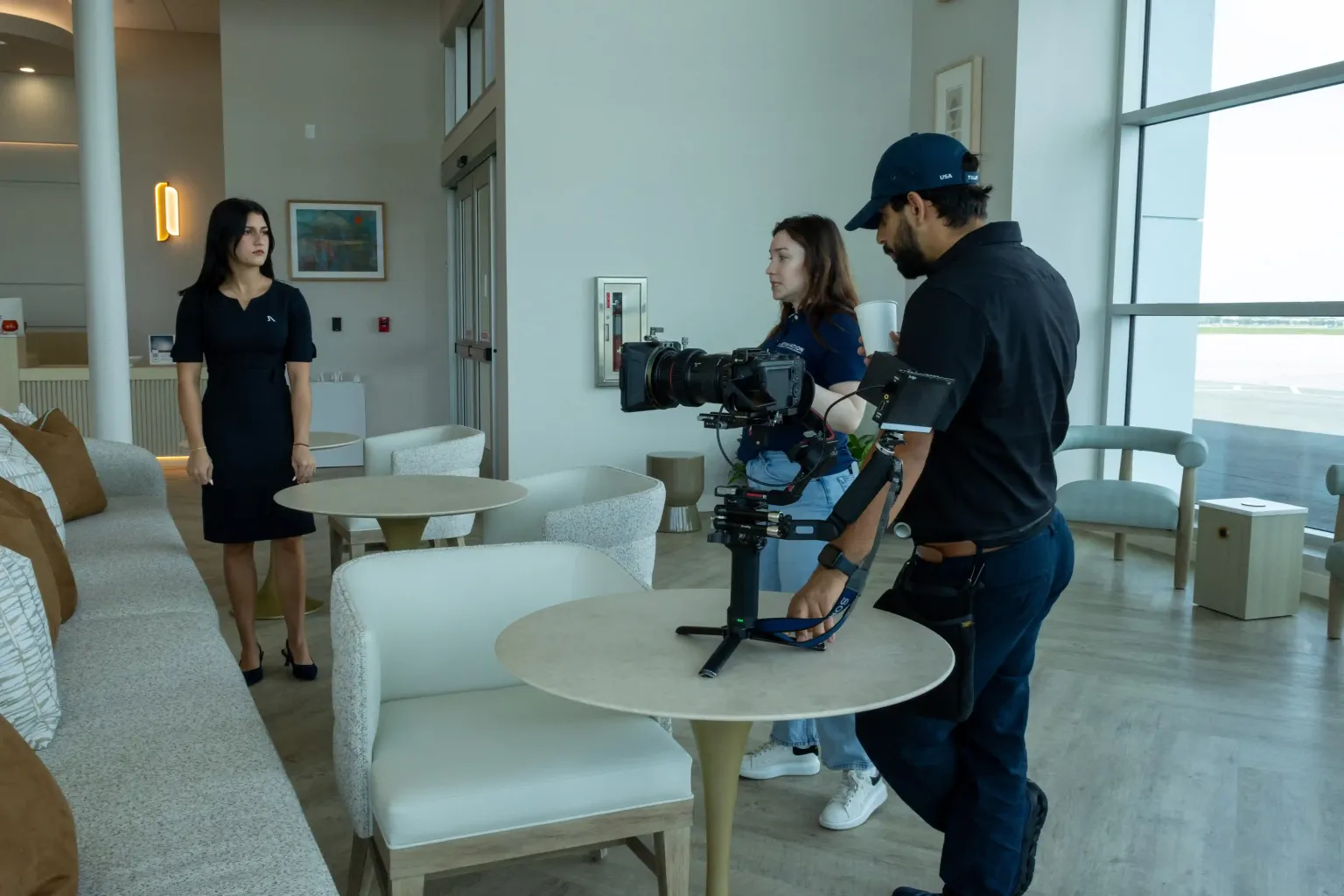


A video shoot in Orlando needs seven things settled before anyone picks up a camera: a defined business goal, an approved budget, a locked script and shot list, cleared locations with permits and insurance, a weather-aware schedule, signed releases, and an agreed delivery list. Miss one, and the cost shows up on shoot day, usually as lost hours you are still paying a crew for.
What makes Orlando different from a generic checklist is the local layer sitting underneath those seven items. Permit lead times to change depending on which side of a city line you park the van on. The afternoon storm pattern is predictable enough to schedule around. Large parts of the metro sit in controlled airspace, and one stretch of it is closed to drones entirely.
This checklist covers the universal planning work and the Central Florida specifics that generic templates leave out.
Start With the Decision You Want the Video to Change
Before format, budget, or location, write down what should be different after someone watches. Not “raise awareness.” Something closer to “shorten the sales cycle by answering the three objections that come up on every discovery call.”
That single line drives everything downstream, including length, tone, where it gets published, and how many versions you need. Lock these before moving on:
- The deadline behind the deadline: If the video supports a March trade show, the real deadline is the print and booth build date, not the show date.
- The audience: One primary viewer, described specifically. A facilities director evaluating vendors is a different video from a job candidate deciding whether to apply.
- The single action: Book a call, request a quote, complete onboarding, apply. One per video.
- The placement: A homepage hero, a paid social ad, a trade show loop, and an internal training module have almost nothing in common technically, and choosing late means reshooting.
- The format: Interview-led brand film, demonstration, testimonial, event recap, or short-form social. Working out which format fits the goal early prevents the common failure of shooting a beautiful brand film when what the sales team actually needed was six product explainers.
- The approver: Name the one person with final sign-off. Projects stall in review far more often than they stall in production.
Build the Budget Before the Creative
Creative expands to fill whatever budget it is given, so set the number first and design within it. Orlando has a wide range because a two-person interview setup and a multi-camera conference shoot are different businesses wearing the same job title. Reviewing what video production actually costs in Orlando before you scope the creative keeps the conversation grounded.
These are the lines that routinely get left out of a first budget:
- Permit and location fees: Free in many Orlando-area jurisdictions, but not all, and park and venue fees sit separately on top.
- Certificate of insurance: Filming on public property requires specific coverage limits and named additional insureds.
- Off-duty law enforcement: Required for traffic control, crowd control, or anything involving weapon-type props.
- Talent, licensing, and usage: Paid actors and stock music both carry term limits that quietly expire.
- A rain or contingency day: Far cheaper to budget than to reschedule an entire crew.
- Captions and versioning: A 16:9 master, a 9:16 cut, and burned-in captions are three deliverables, not one.
- Archive and storage: Someone has to hold the raw footage, and that is a recurring cost rather than a one-time one.
Two Florida-specific budget notes are worth raising with your finance team.
Companies producing motion pictures, commercials, music videos, or sound recordings in Florida may qualify for a point-of-sale sales tax exemption on production equipment purchases and rentals. It requires an approved certificate of exemption rather than simply claiming it at checkout. The Florida Department of Revenue’s film industry page sets out what qualifies and how to apply.
For larger campaigns, Orange County now runs a film incentive program funded through tourist development tax dollars. According to the county’s published program guidelines, commercials require a $250,000 minimum local spend for a 10 percent rebate capped at $50,000, and TV and film productions require a $400,000 minimum spend for a 20 percent rebate capped at $1 million. Applications must be submitted before principal photography begins, which makes it a planning decision rather than a post-project one. Current requirements sit on the Orange County Film Incentive Program page.
Do You Need a Film Permit to Shoot in Orlando?
It depends on the property and the jurisdiction, and the jurisdiction question matters more than most people expect.
Filming on public property in the Orlando region generally requires a permit coordinated through the Orlando Film Commission, which acts as the single point of contact across Orange, Seminole, Osceola, and Lake counties. Filming entirely on private property is usually a different story. In the City of Orlando and unincorporated Orange County, a permit is typically only triggered on private property when temporary structures are erected. A corporate interview shot inside your own office normally will not need one, but confirm rather than assume.
Unincorporated Orange County also carries an exemption where no permit is required if cast and crew total three or fewer using handheld cameras, though the Film Commission notes this depends on the content of the project. Seminole County offers no equivalent exemption regardless of crew size or camera type.
Lead times vary significantly by municipality, and this is where schedules break. Based on the processing notice, each ordinance requires:
- City of Orlando: Five business days, no permit fee.
- Unincorporated Orange County: Five business days, no permit fee.
- Orange County Parks: Thirty days, with park fees applying separately.
- City of Winter Park: Seven business days, submitted through the city’s own online portal rather than the standard application. $100 per permit and up to $500 per day.
- City of Maitland: Ten bus:iness days, $75 per day.
- City of Winter Garden: Five business days, and no filming in downtown Winter Garden Thursday through Sunday.
- City of Ocoee: Thirty days.
- Seminole County: Five business days, $75 per permit.
- City of Altamonte Springs: Five business days, $50 per permit.
- Town of Windermere: Fourteen business days, $100 per permit.
Those figures come from the Orlando Film Commission’s published permitting guidance. Verify current requirements at orlando.org before building a schedule around them, since ordinances and fees change.
Three more permit-adjacent rules catch people out regularly.
The City of Orlando’s noise ordinance runs from 10 PM to 7 AM. Winter Garden runs 9 PM to 6 AM. Winter Park splits it, with residential areas restricted from 7:30 PM to 7:30 AM and commercial areas from 10 PM to 6 AM. A night exterior in a residential Winter Park neighborhood is a much smaller window than it looks on paper.
Also, neighborhood notification has its own deadline. When filming in a City of Orlando neighborhood, notices must reach surrounding neighbors at least two days before the shoot date and cannot be delivered after 7 PM.
Traffic restrictions require a Maintenance of Traffic plan or sufficient officer support, road closures need a minimum of five business days’ notice, and traffic engineering generally favors closures during off-peak hours between 7 PM and 7 AM, Sunday through Thursday. Officers are typically required when traffic control, pyrotechnics, crowd control, firearms, weapon-type props, or the portrayal of a crime are involved.
The Insurance Certificate is What Actually Delays Permits
More permits stall on paperwork than on approval. The minimum certificate of insurance for filming on public property in the Orlando region is a general liability policy of $1,000,000 each occurrence, with the city or county named as an additional insured. Requirements vary by jurisdiction, and some also call for workers’ compensation coverage.
If the project involves special effects, the bar rises sharply. Explosive or pyrotechnic effects must be carried out by a certified special effects technician, and the permit application has to be accompanied by a certificate of insurance naming the city or county as additional insured for $5 million.
Request the certificate from your insurer the same day you confirm the location. Naming an additional insured is a small administrative task that routinely takes a week to come back.
When Should You Schedule an Outdoor Shoot in Orlando?
November through April is the reliable window for exteriors. Rainfall is lower, humidity is manageable for talent and equipment, and the sky is less likely to change three times in an afternoon.
From roughly May through October, the schedule has to respect the storm pattern rather than hope around it. Central Florida sits in the stretch of the state that meteorologists call Lightning Alley. The National Weather Service office in Melbourne reports that the corridor running from Tampa Bay to Titusville receives more lightning than anywhere else in the United States annually, and that more than 90 percent of it occurs from May through October between the hours of noon and midnight.
That single statistic is the most useful scheduling input in this entire checklist. It tells you exactly when to put exteriors on the call sheet.
Practical scheduling rules for the wet season:
- Schedule outdoor work from first light through late morning and move interiors into the afternoon block.
- Put the rain date on the permit application: The Film Commission specifically asks for rain dates, and adding one later means resubmitting.
- Build a genuine interior fallback, not a vague intention to shoot inside if it rains. Scout it, light it, and put it on the schedule.
- Watch the tropics for anything between June and November. Atlantic hurricane season runs June 1 through November 30, and even a system that never makes landfall near Orlando can close venues, ground flights, and pull your crew into their own storm prep.
- Check the event calendar as carefully as the weather. Convention season fills hotels, crews, and rental houses across Central Florida. Booking a five-person crew during a major show week is a different exercise from booking one in September.
Heat is its own planning item from June through September. Interview subjects in suits under lights need a cool holding area, and a shaded staging area for gear is not a luxury.
What Do You Need to Clear Before Flying a Drone?
Aerials in Orlando require three separate clearances, and having one does not cover the others.
i. Federal Certification
Any commercial drone flight requires a remote pilot operating under FAA Part 107. Ask for the certificate number and verify it rather than taking a portfolio as proof.
ii. Airspace Authorization
Much of the Orlando metro sits inside controlled airspace, shaped by Orlando International and Orlando Executive. Flying there below 400 feet requires authorization, which most operators obtain through LAANC. The FAA allows those requests to be submitted up to 90 days ahead of a planned flight, and the requirements sit on the FAA’s Part 107 airspace authorizations page. Where LAANC is unavailable, manual requests through FAADroneZone take considerably longer, which makes this a pre-production task rather than a shoot week one.
iii. Standing Restrictions
Walt Disney World sits under a standing national defense airspace restriction covering a three-nautical-mile radius from the surface up to 3,000 feet above ground level. Neither a Part 107 certificate nor a LAANC approval overrides it. Stadium restrictions also apply automatically around major sporting events without a separate notice being published each time.
iv. Local Ordinance
This is the layer most articles get wrong. The City of Orlando’s drone ordinance does not ban flying over the city because airspace is under federal jurisdiction. What it restricts is launching and landing within 500 feet of city parks, schools, government buildings, designated venues, and gatherings of more than 1,000 people, with a permit pathway that requires proof of insurance. Practically, that means a planned aerial over Lake Eola is a permitted operation rather than a spontaneous one.
Build drone clearance into the timeline the week you lock locations, not the week you shoot.
Lock Locations, Venues, and Load-In
Scout in person, at the same time of day you plan to shoot. A conference room that looks perfect at 10 AM can be unusable at 3 PM when the west-facing windows blow out the background.
For every location, confirm:
- Power: Circuit locations, available amperage, and whether you need to run from a different room.
- Sound: HVAC cycles, adjacent construction, kitchen noise, and aircraft paths. Ask when the air handler is scheduled to run.
- Light Control: Whether blinds actually close and whether overhead fluorescents can be switched off in zones.
- Access: Loading dock hours, freight elevator reservations, badge requirements, and where the van parks. Downtown Orlando parking is a real line item.
- Permission in writing: Verbal approval from a property manager is not a location agreement.
Hotel and convention venues add a contractual layer that surprises first-time producers. An outside crew working a show at the Orange County Convention Center is generally treated as an exhibitor-appointed contractor, which means a certificate of insurance is filed by the show’s deadline rather than the week of the event. In-house audiovisual providers frequently hold exclusivity over rigging and power, and taking a clean audio feed from the house board is something you arrange in advance with the AV team rather than negotiate at the back of the room. If the project is a multi-day conference, the sequencing involved in planning coverage for corporate events in Orlando deserves its own timeline.
Confirm the camera and audio package against what the space can actually support. A three-camera setup in a room with two working outlets is a plan that fails at 7 AM.
Get the People and the Paperwork Ready
Appearance releases for anyone on camera, property releases for private locations, and parental consent for minors. Chasing a signature after someone has left the building is how usable footage becomes unusable.
Florida requires all-party consent to record private oral communications under Florida Statute 934.03. Silent video in public spaces is treated differently from audio capture of a conversation where the participants reasonably expect privacy. For production, this shapes practice more than it creates obstacles. Post visible filming notices at event entrances and in hallways, announce recording before roaming interviews begin, capture verbal consent on camera at the head of each interview, and be deliberate about leaving lavalier microphones live between takes. If any part of the project involves candid capture in semi-private spaces, get it in front of your legal team early.
Executives who have never been interviewed will be stiff on the first three takes, regardless of how good the crew is. Send questions in advance without expecting scripted answers, book more time than the runtime suggests, and give wardrobe direction. No tight patterns, no logos that will date the footage, and a spare shirt.
One person from your team who knows the building, can unlock doors, and can make a call when the plan changes. Their name and mobile number go on the call sheet.
Build the Shoot Day Schedule Around Real Constraints
A schedule that assumes everything works is not a schedule. Build in the friction.
Your call sheet should carry:
- Call time, wrap time, and location address with parking instructions
- On-site contact names and mobile numbers for both crew and client
- Shot list order, with the priority shot marked so it gets captured first
- Talent call times staggered rather than stacked
- Weather forecast and the interior fallback plan
- Nearest hospital and basic safety notes
Orlando-specific realities to build into the timing: I-4 and the surrounding corridor construction make cross-town crew moves unpredictable, so a company move from downtown to the tourist corridor needs a real buffer rather than an optimistic thirty minutes. Summer humidity fogs lenses when moving from an air-conditioned building to the exterior, so allow acclimation time. And redundancy is not optional in a market where an afternoon storm can cut power. Dual-record audio, back up cards on site before anyone leaves, and never wrap with a single copy of the day’s footage.
For corporate video work in occupied offices, agree in advance which areas are off-limits, whether employees need to be notified, and who handles anyone who wanders into the frame. For event coverage, agree on the must-capture moments in writing, because a keynote handoff happens once.
What Should Be Agreed Before the Post Begins?
Post-production disputes are almost always scope disputes that were never written down. Settle these before the shoot, while everyone is still agreeable.
- The deliverables list, by format: Master runtime, aspect ratios, platform-specific cuts, and whether captions are burned in or delivered as a separate file.
- Revision rounds: How many, what constitutes a round, and what a change beyond scope costs.
- Review process: One consolidated set of notes per round from the named approver, not six people commenting separately.
- Music licensing: Confirm the license covers the intended use, territory, and term, including paid advertising if that is in the plan.
- Turnaround: A realistic edit timeline, with the review windows blocked in your team’s calendars.
- Raw footage: Who keeps it, in what format, and for how long?
Also, decide where the video is going before it is finished, because distribution shapes the edit. Cutting for a paid social placement is a different job from cutting for a website hero, and the platforms Orlando businesses are actually seeing results on should inform that call rather than being figured out afterward.
The Final 72 Hours
Run this list three days out:
- Permit approved and printed, with a copy traveling with the crew
- Certificate of insurance issued with the correct additional insureds named
- LAANC authorization is confirmed if aerials are planned
- Locations were reconfirmed with the property contact by phone, not email
- Talent and crew call times confirmed individually
- Weather forecast checked, and the fallback plan communicated
- Gear tested, batteries charged, and cards formatted
- Releases printed and in the kit
- Neighbor or staff notifications delivered where required
- Catering, water, and a shaded or cooled holding area are arranged
Bringing It Together
Most Orlando shoots that go badly do not fail on the day. They failed four weeks earlier, when a permit lead time was assumed rather than checked, an insurance certificate was requested too late, or an exterior was scheduled for 2 PM in August. The creative work is the part everyone remembers, and the planning is what makes the creative possible.
If a project is already on the calendar and you want the permitting, scheduling, and delivery plan pressure-tested against the local realities above, Eman Films works through it during a discovery call before anything gets scoped.