

Hiring a video production company in Lakeland starts with a clear goal, then a plan for the crew, locations, permits, and final delivery.
A business video moves through three stages: planning, production, and post-production. What happens within those stages depends heavily on the location, the type of project, and what you need the finished video to accomplish.
Lakeland adds a few practical considerations. A shoot inside the city may follow a different permitting process than one elsewhere in Polk County. Drone work has to account for the airspace around Lakeland Linder International Airport. If your production company is coming from Orlando or Tampa, traveling through I-4 becomes part of the plan.
Eman Films is an Orlando production company that films throughout Central Florida, including Lakeland and the rest of Polk County. Here’s how a Lakeland shoot works, what it costs, and what to plan for.
What Does a Video Production Company Do for You?
A full-service production company handles the whole project, from planning and permits to filming, editing, and final delivery.
Before the Shoot (Pre-Production)
Before the shoot, the production team helps determine what to film, who should appear on camera, where the production will take place, and what the final video needs to accomplish.
Depending on the project, that can include:
- Creative development
- Script or talking-point development
- Location planning
- Shot lists
- Crew and equipment planning
- Permit coordination
- Insurance documentation
- Drone planning
Good pre-production is often what keeps a one-day shoot from turning into a two-day shoot.
On Shoot Day (Production)
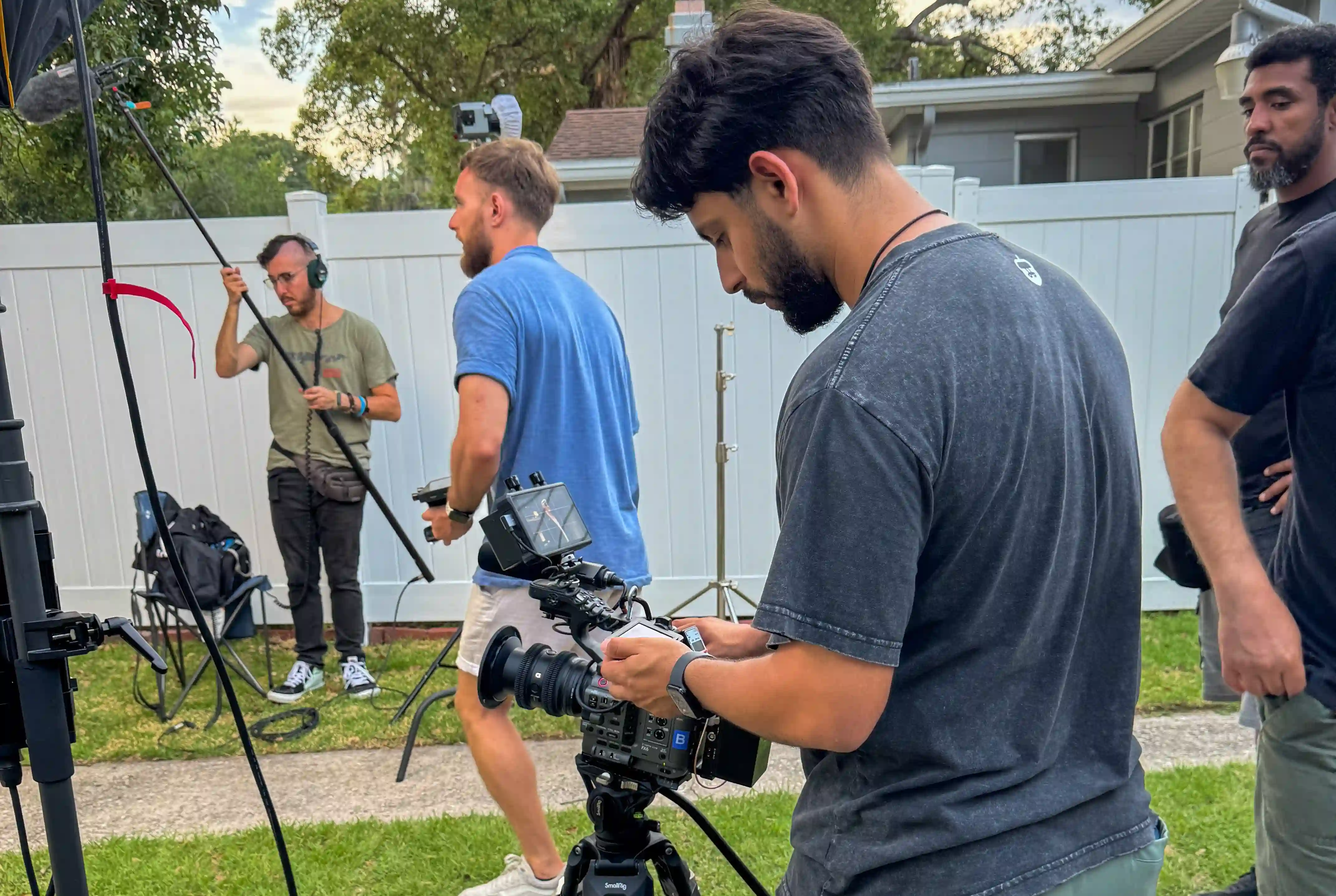
Production is the actual filming. That might mean a single executive interview in an office, a multi-camera event, a company profile filmed across several locations, or a full commercial production involving talent, lighting, sound, and aerial footage.
The crew handles camera operation, lighting, audio, directing, and the practical decisions that keep the day moving.
After the Shoot (Post-Production)
After filming, the team organizes the footage and edits it into the final deliverables.
Post-production can include editing, color correction and grading, sound mixing, music licensing, motion graphics, captions, and different versions for websites, presentations, paid advertising, and social platforms.
Freelancer or Production Company: Which Do You Need?
A freelance videographer can be a good choice for a straightforward assignment such as an interview, event highlights, or a simple social media shoot. You get one person, usually at a lower price.
A production company is a better fit when the job has moving parts: multiple crew members, multiple locations that need detailed pre-production, professional lighting and audio, aerial footage, scripting, or several finished videos.
Choose based on scope first, then on quality. A strong freelancer will always beat a weak production company.
What Kinds of Videos Do Lakeland Businesses Need?
Lakeland has a broad business base, from corporate headquarters like Publix and healthcare systems like Lakeland Regional Health to logistics operations, manufacturers, colleges, and smaller local businesses. Here’s what we see businesses in the area asking for:
Hiring and Training Videos
Warehouses, distribution centers, healthcare organizations, manufacturers, and other large employers hire constantly. Video can show the real work environment, explain the culture, and put faces to the team before a candidate applies. Training and onboarding videos can also reduce the need to repeat the same presentation for every new employee.
Healthcare and Patient Videos
Healthcare organizations often need professional production for physician profiles, patient education videos, facility tours, testimonials, service explainers, and internal communications. For medical interviews, clean audio and lighting matter as much as the camera, and every patient on screen needs a signed HIPAA authorization.
Internal Company Videos
Leadership messages, training, company announcements, town halls, employee stories, and internal presentations can all be recorded professionally without requiring a major production. For organizations with multiple offices or a large workforce, professional corporate video production can also make internal communication more consistent.
Factory and Product Videos
Lakeland’s manufacturing, logistics, distribution, and industrial sectors provide plenty of opportunities for visual storytelling. A plant tour can show production, while a product story can focus on the people, equipment, process, and quality controls. These projects require careful planning because production has to work around employees, machinery, safety requirements, and active operations.
College and University Videos
Lakeland’s colleges, including Florida Southern College, Southeastern University, and Florida Polytechnic University, use video for admissions, campus tours, student stories, faculty profiles, events, and program promotion. A campus production may involve several locations and multiple people, so scheduling interviews and coordinating access in advance can make a big difference.
Event Coverage
Conferences, corporate meetings, fundraisers, launches, ceremonies, and community events need professional event video coverage. Deliverables may include a short highlight film, a full event recording, social clips, attendee interviews, or a combination of these.
Ads and Social Media Videos
Local businesses also need shorter content for websites, paid advertising, Instagram, YouTube, and other platforms. A social media production day can generate a primary commercial or brand video plus several shorter pieces, giving the business more usable content from the same shoot.
Bring Your Lakeland, FL Business Story to Life
From recruitment and healthcare videos to company profiles and product showcases, let’s plan a production that helps your business communicate clearly and reach the right audience.

How Much Does Video Production Cost in Lakeland?
There is no single price for video production because a two-hour interview and a multi-location commercial are fundamentally different productions.
Based on Eman Films’ Central Florida projects, most Lakeland business videos fall between $1,000 and $15,000, although some cost less or considerably more depending on scope.
Typical ranges might look like this:
- Simple interview or short business video: $1,000–$2,500
- Corporate profile or testimonial: $2,000–$5,000
- Recruitment or brand video: $3,000–$7,500
- Multi-location commercial: $5,000–$15,000+
- Larger campaign or multi-day production: $15,000+
These are planning ranges, not fixed quotes.
The final number depends mostly on crew size, filming days, locations, and how many finished videos you need.
What Affects the Price in Lakeland?
Travel is the first factor. A crew coming from Orlando or Tampa may add drive time, mileage, and equipment transport to the quote.
Permits are the second. Polk County’s film permit is free, but insurance, parking fees, and off-duty police for any street closure can still add cost.
The biggest savings come from batching. Filming a recruitment video, a leadership message, and a few social clips on the same day lowers the cost of each one. When you compare quotes, check what each one includes before comparing totals.
Should You Hire a Local Crew or One From Tampa or Orlando?
Hire local for small, single-location shoots and a larger Tampa or Orlando team for complex productions. Lakeland sits between both cities on I-4, so crews from each work here regularly.
A local crew has clear benefits. They know the locations, the property managers, and the traffic. Local producers can come on short notice, and they don’t charge for a long drive. For a straightforward single-location or interview shoot, that’s hard to beat.
A Tampa or Orlando company usually brings more production depth: more cameras, more lighting, a dedicated drone pilot, motion graphics, and a producer. That depth helps when the job is bigger or more complicated.
A multi-location corporate piece, a plant tour with tricky lighting, a college campaign, or anything with serious aerial work usually calls for a larger team, wherever it’s based.
Do You Need a Permit to Film in Lakeland?
Usually, yes. Which office issues the permit depends on where you film.
For productions inside the City of Lakeland, the City’s Communications Department handles film and television permits. The city’s film permit application doesn’t list a permit fee, but you’ll need a $1 million certificate of insurance, or $5 million if the production includes stunts or explosives.
For county-owned sites like Circle B Bar Reserve, start with the Central Florida Motion Picture and Television Office, Polk County’s film office. Its published guidance says permits are free and asks productions to allow about 72 hours for processing. The county also asks for a $1 million general liability certificate naming Polk County as additional insured, sent 72 hours ahead.
Don’t assume a permit for one location covers another just because both are in Polk County.
What Does the City of Lakeland Ask For?
The City of Lakeland’s film permit application can require several supporting documents depending on the production.
These may include:
- Certificate of insurance
- Neighborhood notification letters for neighbors within 500 feet when filming at a residence
- Business notification letters for businesses within 500 feet, plus signed consent from the businesses immediately to the left, right, front, and back, when filming at a business
- A map showing production parking when crew vehicles park on the street
- A map of the filming area for park productions
- A separate film permit or additional information for certain parks
- A Special Event form and off-duty police officers for any street or sidewalk closure
Private property owners may set their own insurance requirements on top of the city’s. The city has no published standard processing time, so apply well in advance.
Where Can Businesses Film in Lakeland, and What Does Each Location Need?
The location you choose affects both the permit process and the production plan.
- Lake Mirror and Munn Park: These public spots in central Lakeland need a city permit and a map of your filming area. Confirm any park-specific rules before you schedule.
- Circle B Bar Reserve: This Polk County nature preserve offers a very different look from downtown. Start the permit with the county film office and confirm park-specific rules with Polk County Parks. Plan around trail traffic, reserve rules such as no music, and opening hours of 6 a.m. to 6:30 p.m. in standard time and 5:30 a.m. to 8 p.m. in daylight saving time.
- Florida Southern College: This is a private campus, so expect to need written permission from the college and proof of insurance before you set a shoot date.
- Offices, clinics, and warehouses: You need the property owner’s permission, and many owners also ask for a certificate of insurance.
Can You Fly a Drone for Aerial Shots in Lakeland?
Yes, but plan it early. Lakeland Linder International Airport puts much of the city in airspace that needs FAA authorization.
Commercial drone operations generally require a certified FAA Part 107 pilot, and the pilot must comply with the applicable FAA airspace and operating rules.
The airport sits about 4 miles southwest of the city. Anywhere within 5 miles of it, drones need FAA airspace authorization first, through LAANC or FAA DroneZone.
Flights also need to stay under 400 feet unless further restricted and within the pilot’s visual line of sight. Flying over or from airport property needs separate permission from Airport Operations at 863-834-4911.
The pilot should check the exact location and altitude requirements before promising aerial footage in the video.
What About SUN ’n FUN?
SUN ’n FUN Aerospace Expo is the biggest event on Lakeland’s calendar. It runs on the south side of Lakeland Linder, and Visit Central Florida expects roughly 200,000 guests, exhibitors, volunteers, and performers. The 2027 dates are April 6 to 11.
During scheduled airshow performances and aerobatic demonstrations, the FAA places a Temporary Flight Restriction over the area that applies to commercial and recreational drones.
When Is the Best Time to Schedule a Shoot in Lakeland?
For outdoor shoots, the drier months from late fall through spring are the safest bet. Plan around these:
- Summer: Afternoon storms are common, so film outdoors in the morning and keep a backup date.
- Hurricane season (June 1 to November 30): Leave flexibility in late summer and fall dates.
- February and March: Detroit Tigers spring training brings traffic and crowds around Publix Field at Joker Marchant Stadium.
- April: SUN ’n FUN adds traffic and airspace limits on the south side.
For outdoor interviews, morning golden hour at Circle B Bar Reserve gives beautiful natural light. In summer, the reserve closes at 8 p.m., before sunset, so evening golden hour isn’t an option.
How Long Does a Video Project Take?
For a single-day shoot, we plan about three to four weeks from kickoff to final delivery. Build in extra lead time before the shoot for:
- Permits: About 72 hours for a Polk County permit. The City of Lakeland publishes no lead time, so apply early.
- Drone authorization: LAANC approves flights at preset altitudes in near real time. Higher flights need a further coordination request at least 72 hours ahead. The FAA aims to respond within 30 days, so file several weeks out.
What Makes a Project Faster or Slower?
Projects move faster when the purpose, interviewees, locations, dates, scripts, deliverables, and approval contacts are settled before shoot day. Most delays come from waiting on someone to approve a location, review an edit, send a logo, or choose a final version.
How Do You Pick the Right Video Production Company?
A good production company should make the process clearer and handle the moving parts for you.
Before you sign anything, run through this list:
- Relevant work: Have they made something like what you need? Ask to see it.
- Insurance: Can they send a certificate of insurance, and name the property owner, the City of Lakeland, or Polk County as additional insured if required?
- Permits and airspace: Do they know which office issues the permit for your location, and can they explain the drone process without guessing?
- Drone credentials: Do they have a current Part 107 certificate and a plan for LAANC or DroneZone?
- Revisions: How many review rounds are included, and what happens after that?
- Deliverables: Which file formats and aspect ratios do you get, and are captions and social cutdowns included in the price?
- Music licensing: Are the tracks properly licensed for commercial use?
- Ownership: Who owns the final video and the raw footage, and can you use it anywhere you like?
What Happens After the First Call?
At Eman Films, the first conversation is about understanding the project before recommending a production.
We start with the goal: who needs to see the video, what you want them to understand or do, and where the finished content will be used. From there, the process normally moves through:
- Discovery call
- Proposal
- Pre-production
- Shoot day
- Editing and review
- Final delivery
If you’re planning a video in Lakeland and want a straight answer on cost, permits, and timing, book a discovery call. Tell us what you’re trying to make and where, and we’ll help you determine the right production approach before you commit to a crew or a budget.